
Falls risk screening is prevention. Early screening helps identify risks before a fall happens. Below you’ll find recommended screenings and assessments, step-by-step guidance, and intervention strategies. Learn more by exploring the CDC STEADI Algorithm for Fall Risk Screening, Assessment, and Intervention.
Recommended professionals to conduct falls risk screenings: Primary Care Provider (MD, PA, NP, etc.), Registered Nurse, Physical Therapist/PT Assistant/PT Student, Occupational Therapist/OT Assistant/OT Student, Athletic Trainer, Exercise Physiologist, and other certified healthcare professionals as appropriate.
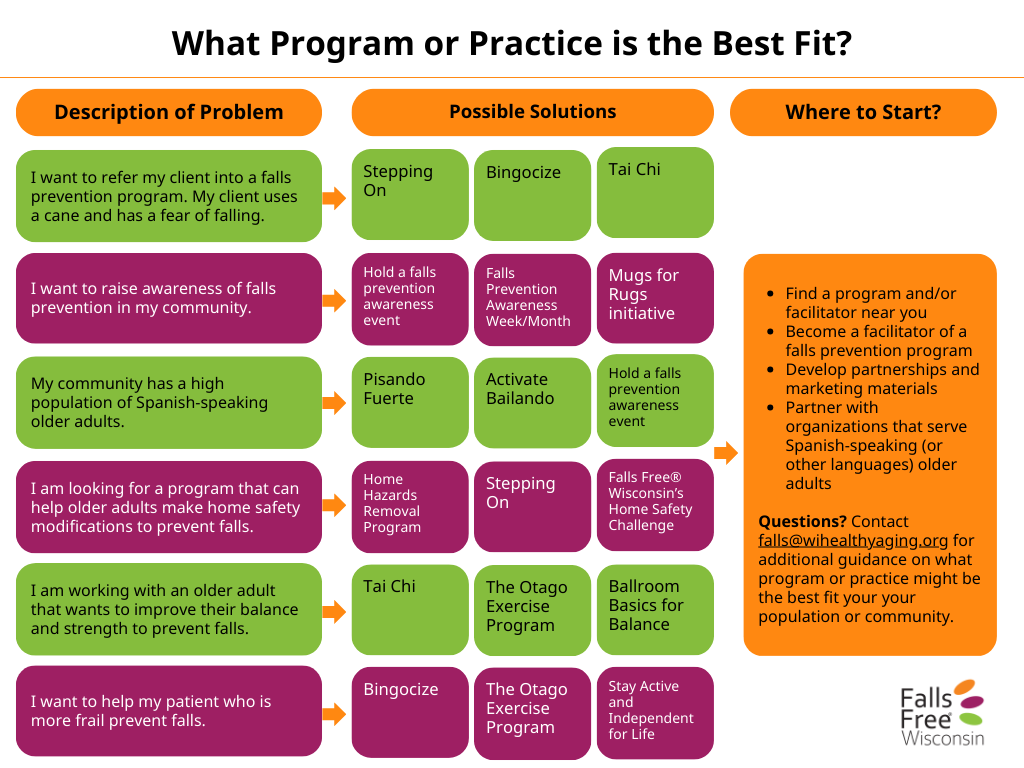
If someone screens at risk for falls, timely action is key. Review step #3 of the CDC STEADI Algorithm. Consider these interventions and implementing or referring them to a community falls prevention and/or exercise program.
Common Assessments
Screening Events & Examples
The Aging & Disability Resource Center of Brown County offers multiple opportunities for falls risk screening:
The Aging and Disability Resource Center of Portage County partners with UW-Stevens Point Doctor of Physical Therapy program to host Balance & Falls Clinics. Students provide comprehensive falls screening, a personalized treatment plan, and balance training. UWSP also offers balance and gait screenings at Portage County’s annual falls prevention event in September
Only Leaves Should Fall is a collaborative effort led by Safe Communities’ Falls Free Dane coalition. After lunch and a keynote address, participants progress through a series of screenings provided by Madison College’s OTA program and UW Madison’s PT, Pharmacy and Nursing programs. Screenings include blood pressure, vision, gait, balance, home safety, cognition, and medication. Participants are given a Checklist that is completed at each screening so that by the end of the event, each participant has a good idea of 1) what their fall risk is, and 2) what may be attributed to that risk.
Local organizations have booths at the event so participants can connect with valuable services and programs that can help them on their fall prevention and resilience journey. Students are paired with a small group of participants and stay with them through the duration of the event and serve as “buddies” to help participants navigate through screenings and do some goal setting at the end of the event. Thirty-day follow-up is provided for those who are interested. The event is always free to participants, and space is available on a first come, first served basis.
Orthopedic & Spine Therapy’s Occupational Therapists provides free balance screening events throughout the year. Screening events are typically held at their Appleton location (or Mary Beth Nienhaus Activity Center in Appleton), but if that is not a convenient location for the patient, they can be scheduled at any of their clinics with any provider (for free!). They use the TUG Test, the 4-Stage Balance Test, and the 30-Second Chair Stand Test, as well as administer a self-assessment in order to better guide if a person is a good fit for 1:1 therapy. If they score “well” in these categories, but are still concerned, they often will recommend them to a Stepping On or StrongBodies course that is happening soon. Flyer | Screenings | Self-Assessment
Following a 911 encounter for a fall, the Menomonee Falls Fire Department Mobile Integrated Health division will make an in-home follow-up visit, utilizing STEADI and Social Determinants of Health screenings to assess for deficits and address as necessary. During the visit, patients will be interviewed and screened for hazards that may contribute to fall risk, including a medication review, TUG test, 30-Second Chair Stand, and the STEADI algorithm. Depending on the results, fall risk reduction information and supplies will be provided at no-cost to the patient. This is all possible thanks to the LEAF grant, which allows the department to provide some of our most vulnerable community members motion-activated night lights, reacher-grabbers, and shower chairs and grip mats.